
Big Tech getting bigger
And also: Apple changes the rules of the digital economy. The Chinese government takes control of the local Big Tech. Snapshots of the future: what is attracting investors

The pandemic made Big Tech bigger, and the effect is accelerating
Post-pandemic expectations reinforce the Big Tech platforms, just like the pandemic did: This month last year we were discussing how the 5 Big Tech companies were actually being reinforced in the first month of the pandemic, for different reasons but always as a consequence of the acceleration of all things digital in our lives. Interestingly, as investors consider the post-pandemic scenarios the conclusion is the same. Last week the whole group presented quarterly results, and the overall signs were very positive, with massive annual growth rates (Alphabet / Google: +32% to $55.3bn/Q; Amazon: +44% to $108bn/Q; Microsoft: +19% to $41.7bn/Q; Apple: +54% to $89.6bn/Q; Facebook: +48% to $25.4bn/Q). The FT this week even identified this as a problem for SPACs, because retail investors don’t need to take any risks when they can get exposure to these growth rates in companies of this size. In aggregate, this is equivalent to creating more than $90bn of new revenues per quarter in just 1 year. Not too bad… (FT)
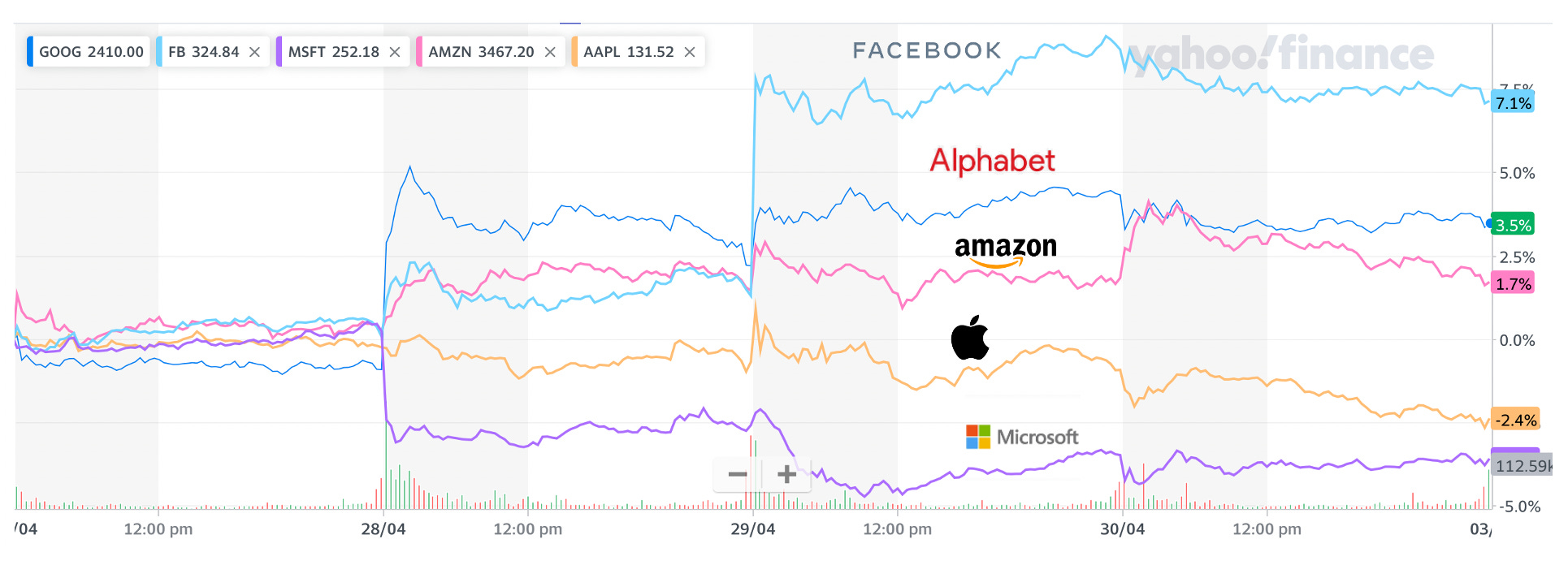
Investors reaction to these results has been diverse: Very positive for Facebook and Google, a sign of the good shape of the digital advertising market, which has grown more than what people expected. Let’s see what will happen after Apple’s launch of the iOS privacy control, although this could even be beneficial for both Google and Facebook, which own some of the sites and services that concentrate internet users’ attention. Then there was a relatively positive response to Amazon’s and Apple’s numbers, for whom the positive surprise was lighter. Apple’s shares fell later in the week due to regulatory actions against them in Europe. Finally, Microsoft’s results were received with a relatively negative reaction, even if they also beat expectations. The WSJ said that “in a frothy market, only blowout results seem to count”, and they may have a point
Big Tech stocks in the last week:
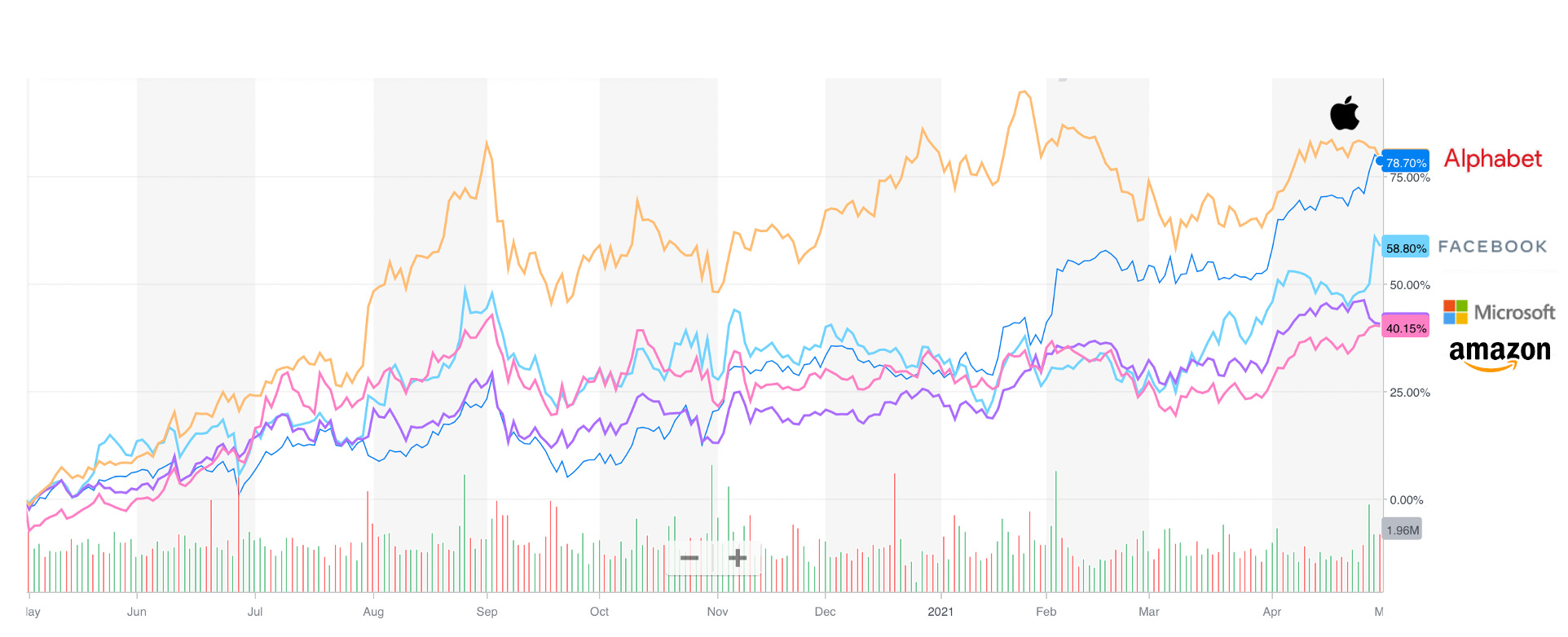
In any case, the summary for the whole pandemic year is rather impressive (see the chart below). The aggregated market cap for the “Big 5” went from $5trn at the end of 2019 (when we were already so impressed) to $8trn at the end of 2020. And it is still growing. Both the WSJ and the FT discussed this effect this week. The increasing strength of the 5 Big Tech platforms, accelerated with the pandemic, may provoke more and harder reactions from regulators in the coming months (WSJ)(FT)
Big Tech stocks in the last 12 months:
Let’s discuss the results in a bit more detail:
Facebook: sunny quarter, but maybe clouds ahead? Facebook’s results came later in the week vs. Google’s, so investors were already prepared, but the reaction was exuberant in any case. The company posted a huge increase in quarterly revenue and profit. And even the admission that growth could slow down later in the year, due to more difficult comparables (this quarter growth was mentioned vs. 1Q20, which was weak due to the start of the pandemic) and also to the potential impact of Apple’s new policies on the digital advertising market. An additional sign of a potential future weakness was the confirmation that the blue app had not recovered the 3m daily active users that it had lost in its more lucrative markets (US and Canada) last year. This is relevant because these markets are disproportionately critical for the company’s revenues, with an ARPU of approx. $16/month (12x vs. the global ARPU). Finally, the company updated the market on its ongoing efforts to develop alternative monetization engines, including e-commerce and payments, in what looks like a replica of what has worked so well for Tencent (WSJ)(WSJ2)
Alphabet / Google: riding a digital advertising wave. Like Facebook, Google is having a higher than expected demand from advertisers, in what is perceived as a sign of optimism from thousands of medium and small enterprises, which are expanding their advertising budgets in anticipation of a boom in consumption, when the economy reopens. The market is going so well that Google is growing +34% even at the same time as it’s losing share in its core search-advertising market, where they’ve fell from 61% to 57%, while (quite interestingly) Amazon has grown from 13% two 19%. From a purely financial perspective, the announcement of a $50bn buyback was also positively received by investors, as a large but reasonable figure, given that the company is already generating more than $50bn cash flow per year (WSJ)(WSJ2)(FT)
Amazon: firing on all cylinders. Maybe investors’ reaction this week was not so strong as with Facebook or Google, but Amazon’s numbers were pretty impressive. Maybe it’s just that everyone expected them to be so… Quarterly revenue was (for the second time in a row) higher than $100bn, and the guidance for next quarter is beyond $110bn. The company keeps dominating e-commerce, which has boomed with COVID, and now the biggest challenge looks to be within Amazon itself, linked to logistics, and to enabling same-day deliveries, which are “not quite” a reality yet in the US. The other areas where Amazon has expanded are doing great. In digital advertising, Amazon is well positioned to capture the shift to “native” tracking, with the sites that customers visit most often (rather than the ad tech companies tracking activity across different sites) now best positioned to personalized ads. If regulators allow them to keep doing this, Amazon will keep winning ad market share against Google or Facebook, exploiting their unique position as a place where people go to buy anything. Ad revenue growth is accelerating, now +77% per year (!!) and total ad revenue already reaches $6.9bn/Q ($25bn on an annual rolling basis). Meanwhile, the other big “alternative” revenue growth driver, cloud infrastructure services, with AWS, is also healthy, growing +32% year on year, to reach $13.5bn/Q and close to $50bn per year (rolling basis). Only physical stores (Whole Foods) are suffering (-16% yoy) but then there are “hidden” values in that asset too, like its role as a network of fulfillment centers for e-commerce and (at the same time) edge computing sites for AWS (WSJ)(FT)
Apple: the iPhone keeps propelling the company, amid concerns for chip shortages. The iPhone 12 (the first one with 5G connectivity) has been a hit with customers, and this has helped Apple deliver an impressive +54% annual revenue growth rate, to almost $90bn per quarter, the largest figure for the “Big 5”, excepting Amazon (which is different because of its role as a retailer for other companies’ products). iPhone revenues actually grew +66% to $47.9bn per quarter (more than half of total sales). The pandemic seems to have helped Apple in multiple fronts, including sales of Macs for people working and studying at home. In parallel to this, Apple keeps successfully exploiting its massive iOS customer base with subscription services that already has 660m paying customers globally (+40m in just the last three months). Now the biggest concerns are (1) regulation, with antitrust demands under way for anticompetitive behavior at the App Store, and a negative decision for the company just announced in Europe, and (2) chip shortages. Apple has largely been immune to the semiconductor crisis up to now, as the most profitable customer of TSMC and others, but pain could start in the coming quarters: Tim Cook himself mentioned at the conference call this week that some of its suppliers could struggle to meet their demand, especially in more basic / “legacy nodes” (WSJ)(WSJ2)FT)
Microsoft: (investors can’t get no) satisfaction. As we’ve already explained, and unlike what happened with the other Big Tech companies, investors reacted coldly to Microsoft’s quarterly results this week. It’s not that they were bad. Like Amazon, the company has a very strong position in the enterprise cloud segment, where they keep capturing market share vs. AWS, with Azure growing +50% (vs. AWS’s +32%) to reach $7.8bn/Q (vs. AWS’s $13.5bn). If you add Microsoft app business (including Office365), the total “Intelligent Cloud” segment is already bigger than AWS ($15bn/Q). Then, like with Apple, the pandemic has helped them grow fast in devices, including PCs and video game consoles (and associated content). So the overall revenue growth beat analysts’ expectations. But investors apparently expected more, and the share price fell after the results were announced. Part of what may be happening is that, with Microsoft already so big (close to $2trn market cap) and growing at this rate, the company “can no longer fly under the (regulatory) radar” (to use the WSJ’s words), so keeping the pace could become more difficult in the coming months (WSJ)(WSJ2)(FT)
Apple changes the rules of the digital economy
Apple has launched its new privacy rules for iOS: After months of expectation and debates, Apple finally launched iOS 14.5, which includes the new privacy rules everyone was talking about. In fact this doesn’t look like a big deal, as iOS users already had the option to ask “not to be tracked” by apps, but it was an opt-out feature. Now it has been turned into opt-in , with consumers being explicitly asked when they open the apps, and this changes everything. The implication is that third party apps running on top of iOS (i.e. on iPhones) won’t have the “right” to use the “IDFA” (a device identifier) unless the user explicitly accepts. If most users don’t (as everyone expects) this could weaken the digital advertising business model (ads have less value if they’re not personalized) and this could change the way money is made in the internet. The digital ad industry generates $350bn, and part of those might be under threat (FT)
This can change the way money is made in the Internet, to Apple’s favor… If digital ads are less valuable, app and content providers could be pushed to shift to a different monetization model, based on direct payments by consumers. Interestingly, this would clearly benefit Apple, because the company gets a 15-30% on every economic transaction through iOS apps (distributed through the App Store). In addition, Apple is also preparing to expand its already substantial ($2bn, with 80% margin) digital advertising business, based on inventory within the App Store. This has a limited scope (e.g. only app developers would initially be interested in this apps) but shows how Apple could now exploit the advantage of having more information than anyone else about what end users do on top of iOS. The result of all this is that a massive opposition to the new policies has emerged within the industry, apparently beyond Apple’s own expectations, and different initiatives have emerged to build alternative tracking mechanisms that would bypass the controls, including one in China, another one by Snapchat’s parent Snap, and others by adtech groups (FT)(WSJ)
Apart from Apple, and maybe counterintuitively, other Big Tech firms could also benefit from this: A counterintuitive effect is also emerging. If tracking is blocked, then the most powerful position in digital advertising will be held by those companies with more “native” traffic, i.e. with apps that get largest shares of people’s attention. Tracking users across apps has been acting as an “equalizer” that allowed “smaller” apps to have a more complete picture of users’ profiles. Now the best profiles will be owned by Google or Facebook. Sheryl Sandberg has already commented that this could be a “tailwind”. So a new driver for the “big get bigger” trend in the digital economy may have just been born (FT)(Bloomberg)
Finally, Apple might have created a source of (regulatory and reputational) pressure on itself: Implementing the controls is complex, and even more if the emerging scenario is that many players (light and dark) are going to try to circumvent Apple’s protections through ad hoc tools. Apple’s track record as a gatekeeper for the App Store doesn’t make us optimistic. Also, there are initial reactions that the controls are not working for many users, and the “track prompt” is not appearing, even after downloading and installing iOS 14.5. So let’s see if Apple can fix the bugs once and forever, or if this turns into a continuous source of operational problems. The interesting twist of all this is that, if the system would actually end up working, then regulators might be worried by the implicit power that Apple would be showing, and this could cause one more concern for Apple, towards the future (Forbes)
Regulatory pressure keeps increasing on Apple’s App Store: This week the EU’s top antitrust enforcer announced a charge against Apple for abusing its control over the distribution of music-streaming apps through the App Store. This comes after previous accusations e.g. by Spotify, the global leader in the music streaming business, where it directly competes with Apple. At the core of this is the general debate on how to ensure “platform fairness” in cases where a company (Apple here, but also Amazon, Google, Facebook or Microsoft in other cases) owns a platform but also owns some of the apps that are using the platform, and compete with the ones from third parties. So this might be seen as a precedent, and the start of a series of blows against the Big Tech companies. Yes, Apple could be trying to “be good” and protect end-user privacy, but again, the power revealed behind the execution of that plan could hurt the company in collateral ways… (WSJ)
The Big Chinese Techlash
China is making massive moves to control its digital economy. But is this about limiting abusive market power or about politics? In fact, according to the WSJ, there might be little of both elements. Yes, the Chinese Big Tech dominate online advertising in the country, and also account for about half of all VC expense, so they can hedge against potential threats coming from innovative startups. Big Tech firms have also been using “exclusivity” policies for third parties using their platforms, in detriment of competition. All this might justify regulatory actions. But it is also true that there are signs that the Chinese digital economy is far from being a monopoly, and there have even been recent cases of local startups growing to compete against the incumbents, like ByteDance and its successful apps, Douyin and Toutiao. So at the end of the day, the recent “Techlash” seems largely justified by the government’s need to limit the increasing power that internet giants like Alibaba and Tencent were getting. In particular, in the fintech space, there is an element of protection to large state-owned banks, which have been losing power. The problem is that these companies have a bad reputation with Chinese consumers. The mandate for fintech companies to share their data with these “legacy” players could also look like a negative incentive to invest in collecting and analyzing consumer data, that would go in detriment of the quality of service (WSJ)
Competition between Chinese Big Tech is increasing, questioning the need for (market-driven) regulation: ByteDance has captured a significant share of attention from Chinese internet users, mainly through its two main apps: Toutiao (a news feed) and Douyin (the Chinese TikTok). And now they want to use that position to capture market share in other markets, like games, which have up to now been dominated by other players, Tencent in particular. ByteDance has recently acquired two game companies, Moonton and C4-Games, and is planning to use its large user base, which spends a lot of time with the company’s apps, to promote its games, and take share from Tencent, which today controls more than half of the Chines mobile-gaming market. This is seen as an example of how competition is already happening in the Chinese Internet, and as an argument against claims of monopoly power by Tencent or Alibaba, which would justify government’s regulations (WSJ)
Paradoxically, this competitive intensity could contribute to shift power to the government: The New York Times argues that competition between Chinese internet companies could further empower the Chinese government, as companies are trying to make their rivals look bad to the eyes of regulators, instead of correcting their own anticompetitive behavior. So this could turn into a competition between them to please the government. The article also gives some interesting statistics about the Chinese market, with Tencent being a strategic investor in 4 of the top 10 apps, Alibaba controlling 3 of them, Baidu controlling 2 and ByteDance owning the remaining one (Douyin) (NYTimes)
In particular, the Chinese fintech space won’t be the same anymore: Last Thursday, China’s Central Bank and four other regulatory agencies told Tencent, Didi Chuxing and JD.com that they should decouple their offer of financial services from their apps. The rationale behind this seems to be that payments, a central part of these companies’ apps, provide valuable information about people’s financial profiles, so data about the transactions can be used to get a competitive advantage to sell loans and other financial products. As a consequence, the government wants to decouple financial services and payments, and “open” the data about transactions to any provider of financial products. This is basically expanding a restriction that had already been prescribed to Ant Group, which had build a massive “micro-loans” service that exploited transaction data from Alipay, their payment service. This bundle between data and services has generated an enormous growth for the industry, and now there are lots of uncertainties on what will happen next (WSJ)
Ant Group’s valuation could have changed drastically because of this: According to an analysis by Bloomberg Intelligence, Ant Group’s valuation could have gone to as low as $29bn, in the worst case scenario, based on the market value of mainstay banks and financial institutions. This is equivalent to an erosion of almost $300bn vs. the projected valuation in the IPO that didn’t happen last year, that was targeting a $320bn market cap. The reason? The very same restrictions that the Chinese government is now extending to the rest of the fintech companies. So this looks like an important discussion… (Bloomberg)
Tencent and Meituan are now “officially” under the radar: Apart from fintech firms, all large internet companies in China are also under the radar. First, Tencent, also under pressure for its exposure to payments and financial services, is facing a fine of at least $1.6bn for anticompetitive behavior with their music streaming app. This is a market that Tencent dominates, but where the company’s position has recently weakened, with a deal between NetEase (another Chinese internet player) and Universal Music. In parallel to this, Meituan, the third most valuable Chinese internet firm behind Alibaba and Tencent, with a market cap of more than $200bn, is also being investigated for “suspected monopolistic behaviors”. Meituan is a leader in e-groceries, and distributes products from different merchants, which are (apparently) forced to either accept an exclusive agreement, preventing them to use other distribution channels, or just leave Meituan. This has been one of the accusations behind the recent $2.8bn fine to Alibaba (Bloomberg)(WSJ)
Huawei, hurt by Western bans, and relatively immune to local regulation, could emerge as “the Chinese Microsoft”: Huawei is in a process of reinvention. This was clear in the company’s recent results, which showed a -17% decline in sales (to $23bn/Q). The company has basically been forced to abandon the smartphone market, and is now focused on its (core) network equipment business, with 5G products for China and other “friendly” markets, and on diversifying to new businesses. For that the company says it’s increasing its R&D investment, which will partially be dedicated to the development of self-driving, electric cars. The government is obviously trying to help, so Huawei could become a sort of “Chinese Microsoft”, with a large size that makes it possible for them to compete face-to-face with other “Giants”, but at the same time with a relatively low (internal) regulatory pressure (Bloomberg)
Snapshots of the future: what is attracting investors
The narrative of cars as digital devices (and even robots) keeps getting momentum
Like Apple, Tesla presents great results, but warns on potential chip bottlenecks: Interestingly, the key takeaways of Tesla’s 1Q21 are quite similar to the ones for Apple. Results were quite good, with an impressive +74% revenue growth, to reach $10.4bn/Q, driven by sales of their cheapest model (Model Y) and by demand in China (reminds one of Apple, too). Also, on the negative side, the main challenge is the threat of chip shortages, that could affect production and the company’s ability to deliver the approx. 750,000 vehicles that they’re forecasting for 2021. Quite similar to Apple’s own challenge too. On top of all this, Tesla has benefited from their sales of emissions-related regulatory credits to other automakers, a relatively “invisible” business that is already bringing more than $500m/Q revenues to the company, and from Bitcoin trading. Shares reacted a bit negatively to these (rather good) results, due to concerns on the potential impact that the current chip shortage could have on the company’s costs (WSJ)(FT)
Competition grows in autonomous vehicles. Toyota emerges as a leading player: There may be plenty of (justified) question marks on the future of autonomous vehicles, especially in the short-term. We’ve already seen here that hopes are mostly focused now on trucks and long-distance routes, relatively simpler to manage, and with more obvious potential efficiency gains to capture. In any case, competition is growing in the market, and Alphabet’s Waymo, the spin-off from Google X and the company universally seen as a “pioneer” in the field is no longer alone. Indeed, Waymo is looking for investors out of Alphabet, after having received a $3.25bn injection from several companies including Silver Lake, a tech-oriented Private Equity fund, to subdues their journey in search for the right commercial model. Meanwhile, new and stronger competitors are emerging. Toyota was confirmed this week as one of them, after an investment of $550m to acquire Lyft’s autonomous driving unit. Toyota is doing this after having previously acquired the equivalent unit from Uber, and after a partnership with Aurora, one of the leading startups in the field (Bloomberg)(WSJ)
Batteries becoming a strategic asset, but their potential for short-term innovation is under discussion
Is QuantumScape the “new Magic Leap”? Electric cars are expected to create a massive demand of batteries, and specifically of some features that are still limiting the “quality of experience” of end users, including car autonomy (linked to battery duration) and speed of charge. A lot of startups are working in this field, but there is one in particular that everyone is talking about this days, as it has transitioned from “stealth mode” to the public markets, through a SPAC acquisition at a valuation close to $20bn. QuantumScape promises to revolutionize the electric vehicle industry, with a reduction of charging times to less than 15min, and an increase in range of as much as +50%. So far so good. But there have been confusing news about QuantumScape this week, that make it look like a new edition of Magic Leap, the Augmented Reality company that was hot three years ago, creating massive expectations about what they were testing in their labs, that then dissolved after revelations that some of their promotional videos were full of… special effects. This week QuantumScape was accused by an activist firm called Scorpion Capital (maybe an appropriate name…) of being a “scam”. This is the risk with “strategic technologies” that have to be kept in secret. The company’s CEO has rejected the accusations in a recent Bloomberg event. So let’s see. In any case, and even if the accusations were finally unfair, it is clear that the company is facing huge challenges, because, as the article reminds us, it is not easy to move a product from the lab to the factory floor (Bloomberg)
After the pandemic, investors embrace the promise of “predictive health”: COVID-19 has changed many things and accelerated many transitions, but an area that is (obviously) expected to grow after the pandemic is the e-health industry. The combination of more advanced sensors that people can wear and capture real time data about vital constants, with AI algorithms that analyze these data and “predict” physical conditions, is generating lots of interest among new startups. This week we learned about a Finnish company, Oura Health, which has just raised a new funding round at a valuation of approx. $800m, that turns it into a clear candidate to become one more European unicorn. The global market for wearables looks promising, and is expected to grow to more than $100bn by 2027, from approx. $40bn last year. So there seems to be room for doing business here (Bloomberg)
Record funding for new space ventures, for global connectivity and other applications:
Space is hot again, now in its Venture Capital version: Total venture capital investment in the space industry increased +95% in the last 12 months until March 2021, to reach a total of $8.7bn. Almost half of this ($4.2bn) was directed into SpaceX and OneWeb, two “giants” of the industry, but even if we exclude these outliers the total figure grew +52% to $4.1bn, still huge. 11 SPACs have been announced during this year, targeting space startups like Rocket Lab (a New Zealand specialist in rockets) and Spire Global (a cloud-based specialist in space data analytics). This comes as a new wave of interest, after some disappointments by the end of the 90s (including companies like Iridium or Teledesic). The narrative attracting investors now claims that the economics have drastically changed since those times, with much cheaper satellites and with re-usable rockets (e.g. like the ones created by SpaceX). Indeed, according to NASA, launch costs would have fallen by factor of 7 due to these factors. So the expectation is that venture funding will this year will double vs. 2020 (FT)
Eutelsat validates OneWeb as a vehicle to improve connectivity across Europe: Eutelsat, an “incumbent” from the satellite industry, historically focused on broadcast TV, is now exploring the broadband market as its key bet for the future. As part of that, they had already signed deals with Orange and TIM to provide network capacity for rural areas in Europe. This week they moved one step ahead, with the acquisition of a 24% stake in OneWeb, the broadband satellite startup originally owned by SoftBank that was recently rescued by Bharti Airtel and by the UK government, for $550m. This consolidates OneWeb as a rival of Elon Musk’s SpaceX, which owns Starlink, a satellite broadband unit, and of Amazon’s Project Kuiper. OneWeb will now have fresh funding to subsidize the launch of 648 low orbit satellites that they plon to use to provide a global broadband service as soon as next year (FT)
A sustainability problem may be emerging in space, with Elon Musk at the center: Starlink already has 1,400 satellites in orbit, and is accelerating the deployment. There is a controversy emerging, due to potential negative effect of an overcrowding of low orbits, where these satellites are more effective to provide low-latency connectivity. The FCC has just given SpaceX permission to fly a total of 4,400 satellites at just 550km above the Earth (this compares with 36,000km for geo-stationary satellites). And more companies are on the way, including Starlink’s rivals targeting connectivity services (e.g. OneWeb or Project Kuiper) but also those that are thinking on other commercial use cases. There seems to be a need for regulation, but the challenge is to find a mechanism to make it possible, because space is a “common resource” where a diversity of governments and a set of powerful private companies are starting to collide (FT)
Quantum Computing could be closer than expected, if we accept some trade-offs: We’ve already discussed here that, at least according to real experts in the scientific community, we might be living an “overhype” around Quantum Computing, because significant challenges remain to make the technology “revolutionary” for practical purposes, as some have been claiming. In this context, a research team supported by Goldman Sachs and QC Ware, a specialized startup, has recently analyzed the opportunity to accelerate the commercial applications of Quantum Computing by accepting trade-offs on the gains that could be achieved. Their conclusion has been that we could have commercial systems able to price complex derivatives faster than conventional computers in just 5 years, if we accept to use “imperfect” hardware that would only be able to deliver 10-fold gains, rather than the 1000-fold improvements that would theoretically be possible (but that would require stable machines with 7,500 qubits) (FT)